What Is Grooving Metal and Why Does It Matter?
Grooving metal is a sheet metal pre-bending process in which a V-shaped groove is machined along the intended bend line with a CNC groover machine before the sheet is bent on a press brake. Removing material from the inside of the bend makes the remaining wall much thinner, so the sheet can be formed with a much smaller inside radius. This technique is widely used when fabricators need sharp, precise bends, large foldable panels, or decorative edges that ordinary bending cannot deliver.
For stainless steel, aluminum, and other metals used in architectural panels, kitchen equipment, elevator panels, and machine enclosures, V-grooving is often the difference between a clean sharp corner and an ugly large arc.
Grooving vs Direct Bending: What Changes?
The image below shows the same metal plate bent in two ways. The top plate is bent directly without grooving and forms a large outside arc (defective). The bottom plate is grooved first with a V groove and then bent; it forms a sharp corner with no large arc.
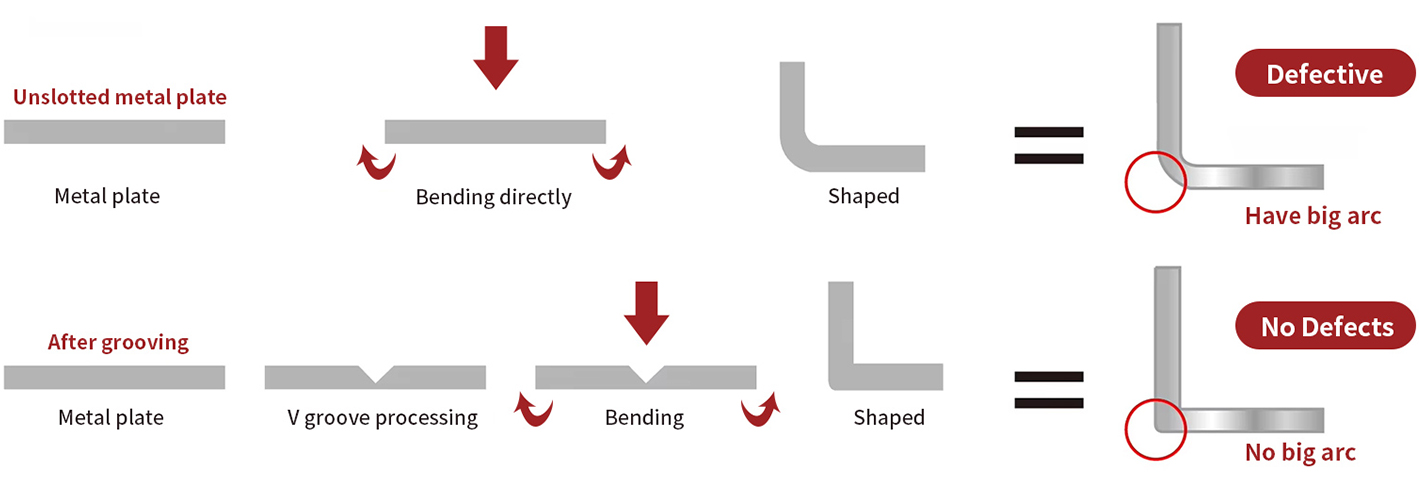
That is the core reason grooving metal exists: it controls where the bend happens and how sharp the corner can be.
How Does a CNC Groover Machine Work?
A CNC groover machine works like a precision milling system for bend lines. The metal plate is fed on a rigid worktable while a servo-driven cutting head moves the grooving blade along the programmed path. The CNC system switches between bidirectional grooving, unidirectional grooving, and fixed-point grooving, so the operator can program the exact groove depth, position, and direction for each job.
Because the tool path and depth are controlled by the CNC system, results are repeatable across batches — the same program produces the same groove every time, which is essential for serial production of panels and enclosures.
CNC Groover Machine Key Specifications
Typical specifications of a sheet metal grooving machine:
| Parameter | Typical Range |
|---|---|
| Plate thickness | 0.6 – 4 mm |
| Cutting speed | 0 – 120 m/min |
| Plate feeding speed | 0 – 20 m/min |
| Worktable flatness | within ± 0.03 mm |
| Grooving blades | 8 synchronized alloy blades |
Frame structure with high-strength bolted connections gives the machine good rigidity and small deformation. The crossbeam is fixed and the worktable is moved by the feed mechanism, which keeps the grooving line stable over long sheets.
Core Components of a Metal Grooving Machine
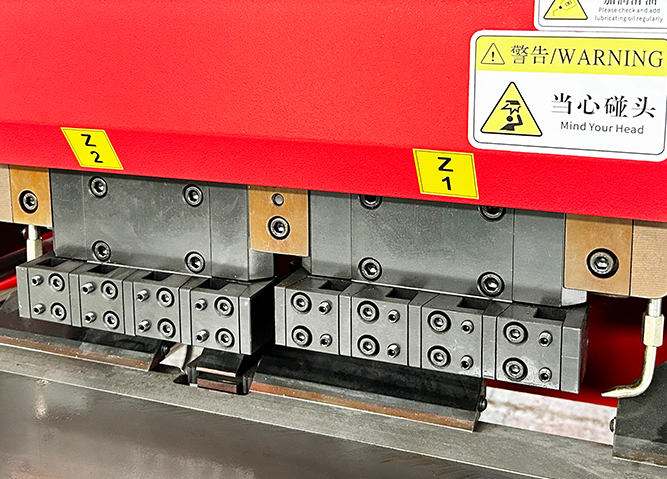
- CNC system: supports bidirectional, unidirectional and fixed-point grooving; shortcut-key programming with online assistant for fast program creation.
- Grooving blades: eight cutting blades perform synchronized grooving; made of high-strength alloy steel for precision and durability, with a dual-nozzle blow-off system that removes chips.
- Hydraulic system: well-known brands such as Japan Yuken provide stable pressure control, low noise and low leakage.
- Servo motors: drive feed rate and cutting depth accurately so grooves stay uniform and the outside radius stays minimal.
- Linear guides and rack-and-pinion: Hiwin guides and YYC rack-and-pinion achieve micron-level positioning accuracy.
- Electrical components: original Schneider parts with overload, short-circuit and leakage protection.
Metal Grooving Applications
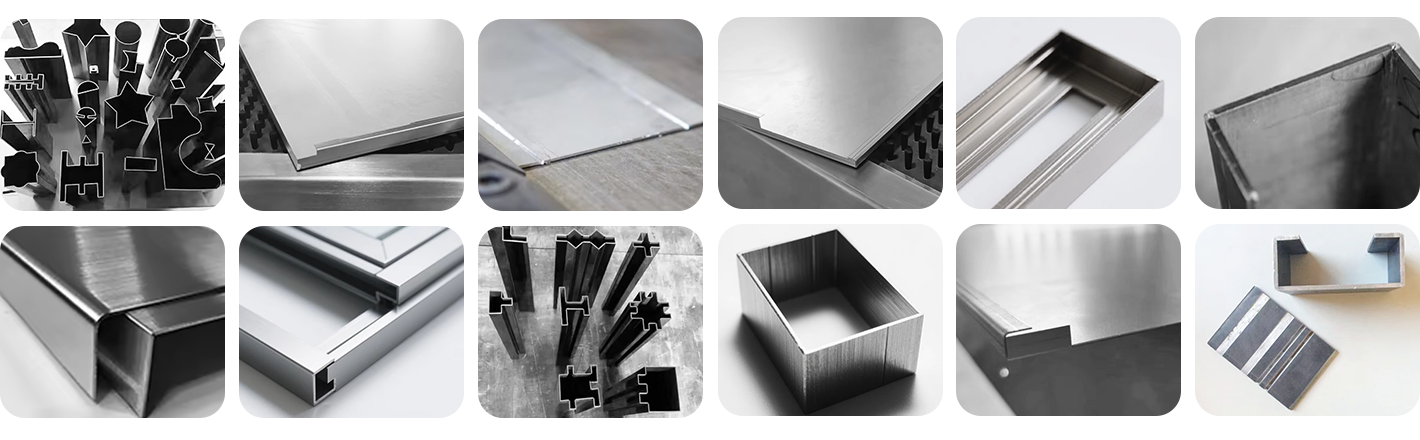
Grooving metal is used wherever sharp corners and tight inside radii are required:
- Architectural metal panels and curtain wall cladding
- Elevator and escalator panels
- Kitchen equipment, sinks and stainless steel furniture
- Machine enclosures and electrical cabinets
- Display, decoration and sheet metal parts with visible sharp edges
How to Choose a Sheet Metal Grooving Machine
When selecting a grooving machine for your workshop, consider:
- Plate thickness range: confirm the machine covers the material thickness you process (for example 0.6–4 mm).
- Cutting and feeding speed: higher speed means shorter cycle time on long sheets.
- Groove accuracy: look for rigid frames, precision guides and a CNC system with repeatable depth control.
- Number of blades: synchronized multi-blade machines cut faster with more uniform results.
- After-sales support: check the manufacturer’s technical service and spare parts availability.
FAQ About Grooving Metal
What is the purpose of grooving sheet metal? Grooving removes material along the bend line so the sheet can be bent with a much smaller inside radius and a sharper corner than direct bending allows.
What metal thickness can be grooved? Typical CNC groover machines handle 0.6–4 mm metal plates; confirm the model range with the manufacturer for thicker material.
Can grooving replace press brake bending? No. Grooving is a preparation step — the grooved sheet still needs a press brake to form the final angle. The two machines work together.
Is V-grooving suitable for stainless steel? Yes, stainless steel panels are one of the most common V-grooving applications because sharp corners are difficult to achieve by direct bending.
How deep should the V groove be? Groove depth depends on material thickness, remaining wall thickness, and the required bend radius; the CNC program controls depth precisely per job.
Maofeng: Groover Machines and Press Brakes Under One Roof
Maofeng manufactures both CNC groover machines and CNC gantry V-groover machines for sharp-corner sheet metal fabrication, together with groover machine solutions and hydraulic press brakes that bend the grooved sheets. Tell us your plate thickness, bend radius and production volume — we will recommend the machine configuration that fits.
Contact the Maofeng sales team for a machine quote: [email protected] or +86-13305558255.